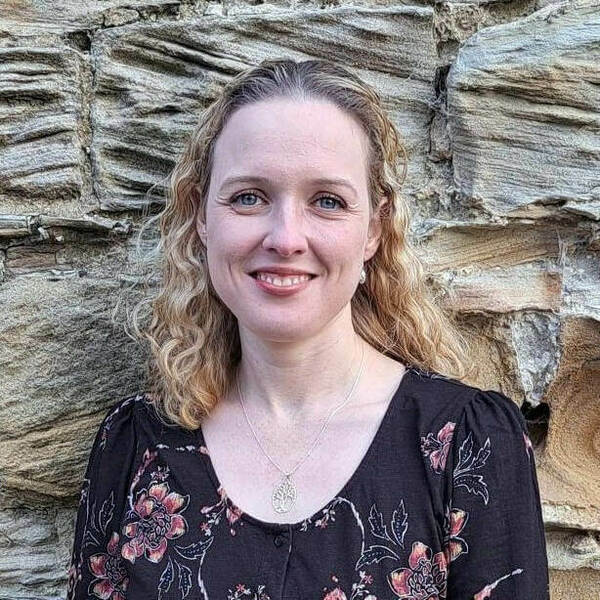
Eilish Gregory is a postdoctoral research fellow at Durham University. In 2024, she was awarded a Research Travel Grant from the Cushwa Center for her project “The Transnational Nursing and Spiritual Activities of the Little Company of Mary in Chicago, 1893–1941.” Recently, she corresponded with Cushwa Center postdoctoral research associate Angela Xia about her research.
Angela Xia: Could you briefly introduce The Little Company of Mary? What about them interests you or warrants further study?
Eilish Gregory: The Little Company of Mary (LCM) is a congregation of women religious founded by the Venerable Mary Potter in 1877 in Great Britain. Since their founding, the LCM have dedicated themselves to serving the sick and dying through prayer and nursing. By the outbreak of the Second World War, LCM foundations had been established in Italy, Australia, Ireland, the United States, Malta, Argentina, South Africa, New Zealand, and Zimbabwe, enabling the LCM sisters to dispense essential healthcare to those in need at a time when women religious orders were spreading globally on an unprecedented scale.
In recent years, studies of early modern and modern women religious by Caroline Bowden, James Kelly, Carmen Mangion, and Laurence Lux-Sterritt have re-evaluated the importance of Catholic women and women religious as patrons and agents, as well as their missionary efforts in Europe and across the globe.1 Likewise, Kathleen Sprows Cummings, Margaret McGuinness, and Mary Beth Fraser Connolly have uncovered the impact of Catholic women and women religious in the U.S. from the late 19th century.2
My research places the role of the LCM sisters within this narrative of female spirituality, devotion, and nursing. I examine how the LCM established their foundation at a time of great urbanization in Chicago (the 1890s), and how they worked with both the Catholic Church and local officials to build a hospital in Evergreen Park, a town just south of the city, in the early 1930s. I also consider how the LCM collaborated with local Catholic priests and officials, dealt with anti-Catholic hostilities, and did outreach both as women religious and as healthcare providers.
AX: During your research at Notre Dame and in Chicago, you consulted a wide variety of sources: archdiocesan records, individual hospital archives, Vatican microfilm, and more. Tell us about what you found. Did anything surprise or excite you?
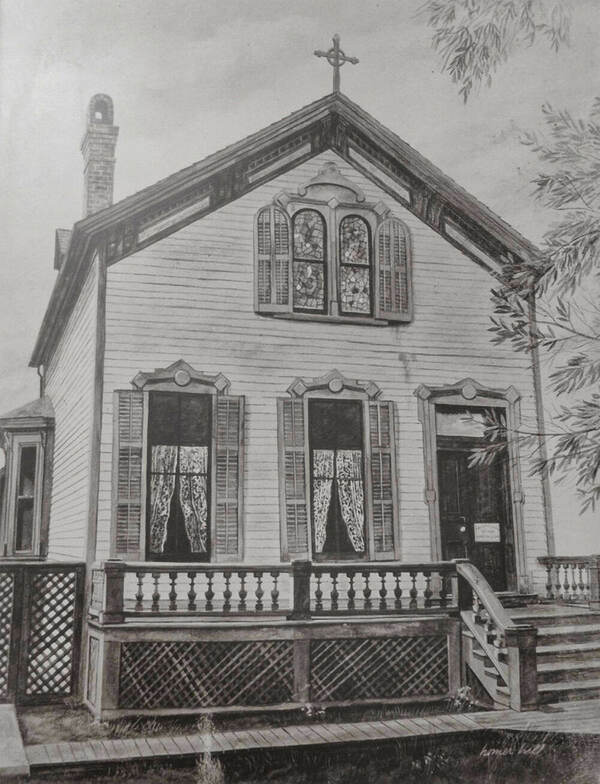
EG: I spent the first three days of my trip consulting records at the Little Company of Mary’s archives, which are housed at an LCM hospital in Evergreen Park, Illinois. I also visited the Archdiocese of Chicago Archives. The LCM’s own archives held rich materials about the congregation’s early history, as well as minute books detailing the activities of sisters.
The archive also contains manuscripts held by LCM sisters based in Buenos Aires, Argentina, revealing the intertwined history of the American and Argentine LCM branches. The first U.S.-bound sisters had a chance encounter with their future Argentinian patron Mrs. Margarita Morgan in 1893, when Morgan and her daughter Maria Clara were traveling to Chicago for the World’s Fair on the same passenger ship as the sisters. En route, Maria Clara fell ill and despite the ministrations of LCM sisters, died before arriving in Chicago. Moved by their care for her dying daughter, Margarita Morgan vowed to found a hospital in Buenos Aires for the LCM to run, and in 1913 her wish was finally fulfilled when a band of LCM sisters travelled from Chicago to Argentina. Sisters from both foundations continued to have close communication during this period.
At Notre Dame, I perused the Newspaper Special Issues Collection (NSI) to see if local Catholic newspapers mentioned the LCM. I also went through microfilm correspondence sent from the Propaganda de Fide, as I was aware that LCM sisters frequently corresponded with different figures in Propaganda for all its provinces worldwide.
While the Newspaper Special Issues Collection and the Vatican microfilm did not yield much, I was able to learn how the LCM did outreach in other ways. For example, the Robert Seton Family papers had a pair of calling cards sent from the LCM sisters to leading figures like Monsignor Robert Seton (CSET II-2-h). Cards like these helped me ascertain the LCM’s relationships with the Catholic hierarchy, especially in regard to their nursing and spiritual activities, which would have played a crucial role in their early days when establishing their roots in their communities and forging new relationships.
One great revelation during my visit at the Notre Dame Archives was discovering how valuable the Catholic Directories were in learning about the growth and impact of the LCM in Chicago. These annual directories contain lists of all the archdioceses in North America and include the names of parishes, male and women religious orders and congregations that resided there, alongside information about any schools, hospitals, and institutions they ran. The LCM first appear in the Catholic Directories from 1895, two years after they arrived in Chicago, and what is really interesting is we can see how they expanded from a small congregation of women religious numbering less than a dozen sisters to running a large hospital treating over a thousand patients by the end of the 1930s.
AX: Running healthcare institutions is a complicated and highly bureaucratic undertaking. From your research, how did members of the Little Company of Mary juggle these responsibilities with their charism?
EG: It was never an easy task for any religious order or congregation to establish a new foundation, and it certainly was not easy for the LCM sisters when they travelled from Europe to the United States in 1893. The LCM sisters not only had to find suitable accommodation to live in, but also had to think long-term about raising money to build convents as well as hospitals to carry out their spiritual devotions and treat their growing numbers of patients. As the Catholic Directories have revealed, by the outbreak of the Second World War, the LCM’s hospital in Evergreen Park treated thousands of patients. As a result, the hospital had a significant workforce made up of LCM sisters—who ran the hospital and worked as nurses alongside professional doctors—and lay women who were training to become nurses.
The charism of the LCM sisters was inspired by the Virgin Mary and the “little calvary” of women who surrounded the cross at Christ’s crucifixion. As described in a letter written by one of the first LCM sisters, Mother M. Philip, the LCM was devoted to “Mary, to help the sick, to stand with the dying and to work for the saving of souls.” My visit to the archives at the OSF HealthCare Little Company of Mary Medical Center helped me to see with my own eyes how the LCM sisters placed their devotion to the Virgin Mary front and center of its ethos. When you enter the grounds of the hospital, there are statues of the Virgin at multiple entrances, while the hospital has a functioning chapel where people can enter for prayers and reflection. As the hospital is about to have a section demolished and rebuilt from the end of this year, a new chapel is being built and has been at the heart of the re-designs and consultations. It is clear the chapel is a core component of the Medical Center, and it affirms just how much spiritual devotion has always been central to the LCM’s ethos and charism to care for the sick and vulnerable while praying to save people’s souls.
AX: You have studied the Little Company of Mary in other Anglophone contexts, such as Australia and New Zealand. What similarities, differences, or other patterns have you found when comparing the different sites of the LCM?
EG: The LCM sisters were founded at a time when modern nursing as we know it today was still in its infancy, with nursing only just starting to become an esteemed profession, and with medical innovations, medicines, and techniques developing at a rapidly fast pace. The LCM sisters were a part of this history, and it has been awe-inspiring to read their correspondence in their archives charting in “real time” to technology that we take for granted today—such as the first telephone wire in their hospital or new staff members.
I have noticed that the LCM sisters who travelled to Ireland, Australia, New Zealand, and the United States in the late 19th century shared similar experiences in their travels. The LCM sisters also knew that some places they were travelling to were not receptive to Catholics or to women religious, which at the time included parts of Australia and New Zealand. I have also uncovered how the LCM sisters were very entrepreneurial in how they raised money to build their own hospitals and convents and were very savvy in how they handled relationships with Catholic hierarchy and benefactors. The LCM’s success was not only dependent on their commitment to their charism to care for the sick and the dying, but it was also reliant on having a strong relationship with people in their community.
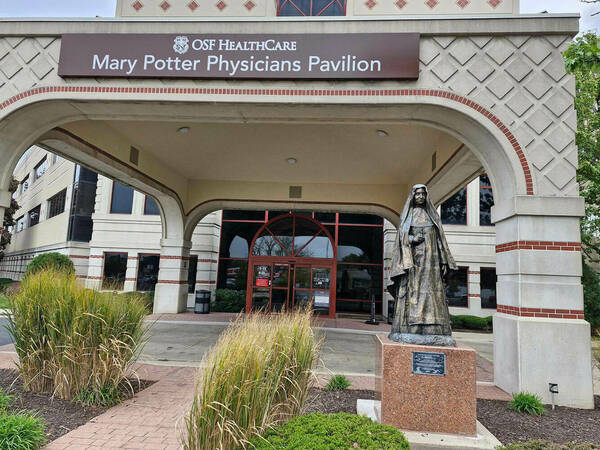
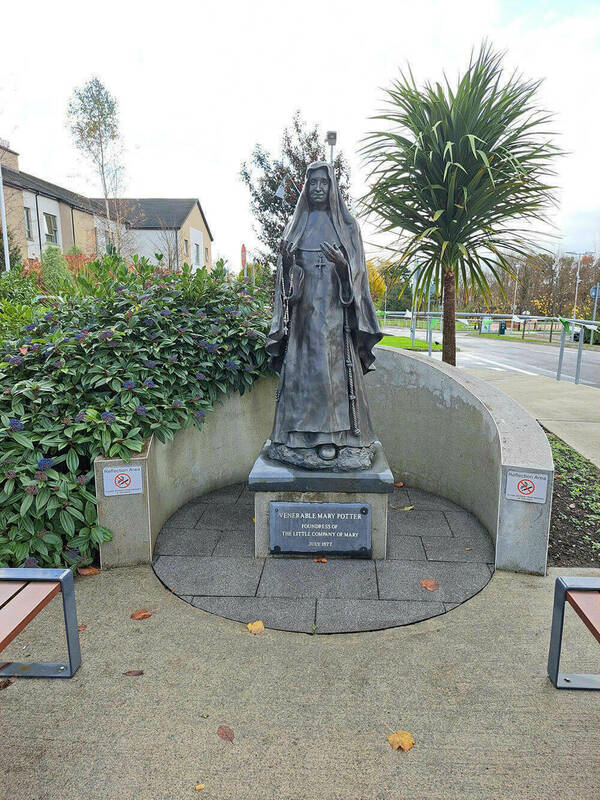
I have observed that the LCM has also long provided diverse modes of healthcare ranging from medical treatment to social and psychological support. In Chicago, the LCM hospital is still running today after nearly a hundred years, while in Limerick, Ireland, the LCM has operated a hospice since the 1920s. In Christchurch, New Zealand, the LCM opened a community center for local people to combat loneliness—an institution situated right next door to the hospital they had originally founded and built during the First World War. Another surprising thing that I noticed is that statues depicting the Venerable Mary Potter are almost identical at their different medical sites—you can see the similarities here at the hospital entrance in Evergreen Park (previous page), as well as at the entrance of the Limerick hospice (above).
AX: Tell us about your next steps for this project. What type of audiences would you like to reach with the story of the LCM?
EG: In March 2025, I will be giving a paper at the Centre for Catholic Studies Research Seminar about my research findings. I am also planning to give a research paper at the annual Catholic Record Society (CRS) Conference in Leeds in July 2025.
As part of my postdoctoral research fellowship, I am currently working towards completing a book manuscript which will be published with an academic press. The monograph will situate the LCM into the wider history of modern women religious congregations and the history of nursing. Since the LCM sisters had a far-reaching impact across the globe, it has made sense for me to tackle the book writing thematically, especially since the sisters frequently travelled to different locations, lived and worked in multiple countries, and often shared similar experiences in their vocation. Although the intended readership of my monograph will be academic, I do hope that the book would also be of interest to those who encountered the LCM in their lives, whether it be delivering their children in hospital or taking care of sick relatives in their final days. Meeting these ordinary people who have been treated by the sisters makes the LCM’s impact more real for me as a historian in a way that I have never encountered before.
This interview appears in the spring 2025 issue of the American Catholic Studies Newsletter.