Hibernian Lecture: Frank Shovlin on John McGahern

Since 1982, the Cushwa Center has hosted the annual Hibernian Lecture. An endowed fund given to the center by the Ancient Order of Hibernians and the Ladies Ancient Order of Hibernians supports the lecture, among other programming. For 2024, the center hosted Frank Shovlin (Institute of Irish Studies, University of Liverpool) for a lecture titled “Like a Prayer: The Novels of John McGahern.”
While Professor Shovlin teaches courses on Irish fiction, the Irish literary revival, and Irish drama, his scholarly expertise is in the work of John McGahern (1934–2006), who dominated the Irish literary landscape in the second half of the 20th century. As the world’s leading McGahern scholar, Shovlin is the author of Touchstones: John McGahern’s Classic Style (Liverpool University Press, 2016) and John McGahern’s Dublin (Dublin City Council, 2021), and editor of The Letters of John McGahern (Faber & Faber, 2021). He is currently writing McGahern’s authorized biography. As he began his remarks, Shovlin noted his ancestral ties to the Ancient Order of Hibernians, the organization having provided important support for the Shovlin family on both sides of the Atlantic in the 19th and 20th centuries.
Shovlin described McGahern as “Ireland’s greatest writer of fiction of the past 60 years,” whose corpus includes six novels and four collections of short stories. Born in Dublin and raised in County Leitrim, McGahern described the Ireland of his childhood in words quoted by Shovlin:
Ireland in the 1930s was essentially a 19th-century nation . . . There was no electricity; it was all candles and oil lamps. Ninety percent of people lived in appalling poverty—but it didn’t feel poor. The most attractive thing about Irish society then, and now, is its lack of class-consciousness: everybody was equally bad off.

Shovlin observed that while the material conditions of McGahern’s early life were probably not quite so dire, the future author did not enjoy an easy childhood. McGahern’s mother died when he was nine, and later in life the author wrote of the pain his father inflicted on him, who “could be brutal and cruel,” in Shovlin’s words, and who abused McGahern physically and sexually. The situation was sufficiently horrific that the young McGahern eventually resolved to kill his own father if necessary to save his siblings from the abuse he had suffered himself. Although such circumstances never came to pass, Shovlin noted that the relationship between McGahern and his father “was always strained”—which would heavily influence McGahern’s writing.
Despite the difficulty of his childhood and what McGahern described as an Irish society essentially obsessed with formal adherence to the practices of the Church, he harbored no ill will toward Catholicism and, like many young Catholic men, contemplated the priesthood. Ultimately McGahern left the practice of the faith and indeed belief in God. Yet at the very end of his life, McGahern made a concerted effort to ensure that his death would be marked by a traditional, Catholic funeral, and that at his burial mourners should pray the rosary while others should pour dirt, shovel by shovel, onto his visible coffin.
McGahern appreciated Catholicism throughout his life, even though his biography might otherwise suggest cynicism or outright opposition to the Church. Shovlin explicitly noted that “it would be a mistake to think of John [McGahern] as anti-clerical in his thinking.” McGahern maintained friendships with priests over the course of his life, and despite his personal loss of faith, as the Church lost influence over Irish society in the 20th century “John feared that the more worthwhile and beautiful aspects of Catholicism would be lost in the race to cosmopolitan modernity.” Furthermore, unlike many accounts by Catholics looking back on childhoods in the Church, McGahern wrote that he “never found the church ceremonies tedious . . . They always gave me pleasure, and I miss them. All the movement of focus from the home and school to the church brought with it a certain lightness, a lifting of oppression, a going outwards, even a joy.”
Even critics noted that McGahern’s writing was “drenched in religion,” and Shovlin called attention to some of the themes that lent power to McGahern’s early writing: “religious vocation; failure to renounce the flesh for a life in Christ; the idea of human existence as a vale of tears.” During the homily at McGahern’s funeral, his friend Father Liam Kelly marveled at the writer’s refusal to take the seemingly reasonable path of opposition to the Church: “Even though he was treated badly, he never held any grudges or traces of bitterness. He was bigger than that. The church was, he said, his first book, and he had learned much from it.”
McGahern was both a keen observer of and a visible “player” in the changing mores of 20th-century Irish society. Shovlin—whose classroom topics include censorship—noted that McGahern’s 1965 book The Dark “was the last serious work of fiction to be banned in Ireland.” Dublin’s Archbishop John McQuaid had McGahern removed from his job teaching at a Catholic boys’ school after the legal condemnation of The Dark under Ireland’s Censorship of Publications Act of 1929. Shovlin speculated that the use of profanity on the book’s first page may have been McGahern’s cheeky way of testing the limits of censorship. On a deeper level, however, the book was ostensibly banned for its frank discussion of sexual abuse by both family and clergy. As such, Shovlin said, “The Dark is the first work of Irish fiction to lift the lid on clerical sexual abuse.” McGahern himself connected the book to his own deep appreciation for Catholicism, writing to a friend that “What disturbs me very much is that the book’s a religious work if it’s anything at all.”
Shovlin explored McGahern’s unique approach to writing. At the outset of his career McGahern wrote that his forthcoming first book was “not a novel, but an attempt to break that form down into a religious poem.” He also described his own writing as “a form of praise and of prayer.” The author declared in a 1967 lecture that “I am only interested in poetry, which occurs more often in verse than in prose.” McGahern ultimately contradicted his own framework and achieved far more through his poetic fiction than more traditional verse poetry.
Shovlin considered at length the artistic foundations of McGahern’s writing. He drew parallels between the work of McGahern and W.B. Yeats. Shovlin mentioned the two writers’ “suspicion of writing that is ‘mere story-telling’ . . . always in search of deeper, more permanent significance.” He noted that this is precisely the reason that much of McGahern’s work is not set in any clearly delineated time. While readers could easily imagine his stories taking place in their own time, they were written to unveil timeless truths about humanity.
During the lecture’s question and answer period, a student asked what drew him to study McGahern. Shovlin responded by chronicling more than three decades of engaging with McGahern’s work, starting with reading him in 1990, studying under him in 1993, and later efforts culminating in collaboration with McGahern’s widow on his letters and authorized biography. In response to another question, Shovlin noted that McGahern’s writing had an effect on him that has clearly been repeated for many other readers: Despite a youth and life without many of the same struggles as McGahern, reading the Irish author’s way of describing the world remains arresting.
Cushwa Center Lecture: Candy Gunther Brown on Francis MacNutt
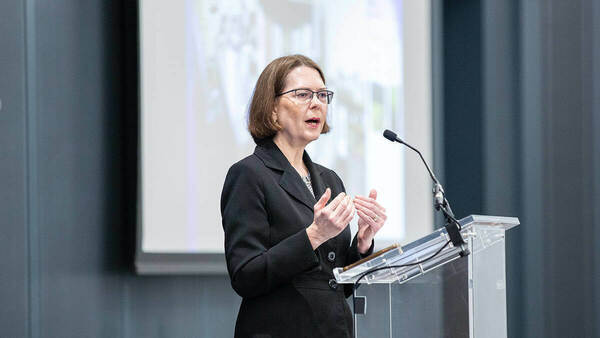
The Cushwa Center Lecture series, which addresses various aspects of religion and public life, began with an inaugural address, “From Personal to Private, From Political to Public Religion,” by Martin Marty in 1984. Offered occasionally through the 1990s, at the turn of the century it increased in frequency and become an annual event after 2009. On October 4, Candy Gunther Brown (Indiana University) offered the 2024–25 Cushwa Center Lecture, titled “Francis S. MacNutt and the Globalization of Charismatic Christianity.”
Brown’s work explores the intersections of prayer, science, religion, and medicine and has been supported by the Louisville Institute, the John Templeton Foundation, the Mellon Foundation, and the Cushwa Center. She is currently completing a critical biography of Francis MacNutt for the Eerdmans Library of Religious Biography. Her past publications include Debating Yoga and Mindfulness in Public Schools: Reforming Secular Education or Re-Establishing Religion? (University of North Carolina Press, 2019); The Healing Gods: Complementary and Alternative Medicine in Christian America (Oxford University Press, 2013); and Testing Prayer: Science and Healing (Harvard University Press, 2012).
Brown’s lecture traced the life and career of Francis MacNutt—playwright, actor, poet, World War II medical technician, Dominican priest, faith healer, author, ministry founder, husband, and father. While such a litany of MacNutt’s descriptors may seem haphazard, each element came as a result of thoughtful engagement with the world. He was born in St. Louis in 1925 to artist parents, who themselves seem to have prefigured MacNutt’s later ecumenical work: His father had converted from Presbyterianism to Catholicism, and his mother had left Catholicism for the Episcopal Church but later left that tradition, as well. MacNutt attended Harvard; his education was intended to lead to a medical career. Yet his military service disillusioned MacNutt from his aspirations to be a doctor, and he instead embraced theater after the war.
In 1950 MacNutt changed paths again, entering studies with the Order of Preachers (Dominicans). He was ordained a priest in 1956. The beginning of his priestly life continued a foundational element of MacNutt’s understanding of the world, encapsulated by one particular stream of what might be called “theological psychology”: As Brown noted, MacNutt long believed that only suffering could produce holiness. He felt guilty about feeling even fleeting happiness and sought therapy “as a necessary concession to keep going” through a life marked by the tension between desire for holiness and fear of happiness.
In the 1960s MacNutt was introduced to the notion of healing via prayer. In 1966, he met Manchester College’s Joan Kimmel, who introduced MacNutt to “baptism with the Holy Spirit.” The next year, MacNutt attended Camp Farthest Out in Chattanooga and had a faith experience of “joyful laughter that he interpreted as baptism with the Holy Spirit,” Brown said. Ten years after his ordination as a priest, it seemed that MacNutt had finally received divine approval to be happy. Eventually, MacNutt would invert his previous view of suffering. Rather than suffering caused by illness being an opportunity to advance toward holiness, he came to believe that sickness came from Satan while healing came from God. In this framework, Brown explained, “Healings functioned sacramentally as a visible sign of invisible grace, and were central, not peripheral, to the Gospel.”
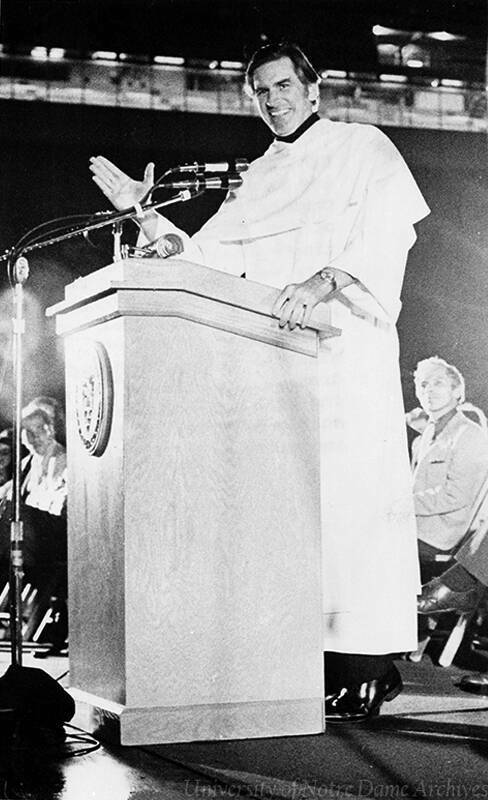
MacNutt became a leader in the Catholic charismatic renewal (CCR), the American Catholic Charismatic Leadership Conference, and the Association of Christian Therapists. The early 1970s saw MacNutt’s popularity skyrocket beyond these organizational structures. His book Healing, jointly published by Ave Maria Press and Bantam, was a runaway hit. In 1974 he led a healing service attended by some 30,000 at Notre Dame Stadium. Such services were central to MacNutt’s ministry. Amid the praise and adulation MacNutt began to receive as he traveled the world offering healing services and individual prayer, some followers proposed MacNutt be canonized as a saint before he died—a hyperbolic notion well outside the confines of Catholic orthodoxy, even given the inconsistencies of canonization norms over the centuries. Less outlandish, however, was how MacNutt pioneered in demonstrating therapeutic value in adding prayer to medicine, “striking a middle way,” Brown said, “between those who dismissed the value of prayer in physical healing entirely and those who relied solely on prayer toward physical wellness.”
Unsurprisingly, in light of the multiple areas of vigorous debate in the Church in the late 1960s and the early 1970s, MacNutt found himself involved in a number of controversial issues. While his eagerness to partner with women, including non-Catholic women, in healing services and other events made his work even more popular in places like Latin America, such collaboration raised eyebrows in other corners of the Church. MacNutt also began to question priestly celibacy, observing during his travels a significant proportion of priests disregarding this promise with the tacit acceptance of their bishops, who nonetheless insisted on the importance of celibacy. MacNutt found such incoherence to be not only hypocritical but seriously demeaning of the women whom such priests courted but had no intention of joining in a public relationship.
As the 1970s wore on, the charismatic movement within Catholicism enjoyed significant support, including among well-placed clerics like Cardinal Leo Suenens, the archbishop of Mechelen-Brussels who was launched to enormous visibility during the Second Vatican Council and afterward. Brown noted that MacNutt also found support, if informal, from Pope Paul VI. Eventually, though, MacNutt outpaced the hierarchy’s approval of the charismatic movement. He was summoned to Rome in 1978 and ordered to rein in his activities. Specifically, he was instructed to end the practice of “slaying in the spirit,” which involved commanding demons to leave those who presented themselves for healing while looking them in the eye, and often resulted in those who had ostensibly been healed falling to the ground. Suenens warned MacNutt that he was “seriously impairing the CCR’s credibility and dabbling with great dangers.” Importantly, however, these restrictions were not intended to cast doubt on the spiritual reality of faith healing.
The 1978 restrictions foreshadowed MacNutt’s later break with the institutional Church. In 1980 he married Judith Sewell, despite the denial of his sincere request for dismissal from the clerical state. MacNutt was summarily excommunicated and, as Brown related, his writings were banned from many Catholic publications by the Congregation for the Doctrine of the Faith. With his wife, MacNutt continued his healing ministry; the couple founded Christian Healing Ministries and carried out their work until MacNutt’s death in 2020. By the time of his death, MacNutt was reconciled with the Church. His excommunication had been lifted in 2007 with Pope Benedict XVI—the same man (Joseph Ratzinger) responsible for the publication ban decades earlier—giving his “personal thanks” for MacNutt’s work of “bringing healing to the Church.”
During the question and answer period, Tom Kselman (emeritus, Notre Dame) asked whether MacNutt ever incorporated more traditional elements of Catholic devotion into his work; Kselman cited the healings reported at Lourdes as an example. Brown noted that while MacNutt did deploy sacramentals and offer the sacraments, the intentionally ecumenical nature of his work complicated the integration of such traditional practices into charismatic events. In this, perhaps, the undeniably unique MacNutt was emblematic of a strain of Catholic practice in the transitional and experimental period after Vatican II, holding on to that which could support a new understanding of the power of God in individual lives, overtly and exuberantly expressed.
Dolan Seminar: Emily Conroy-Krutz’s Missionary Diplomacy
Since 1980, the Cushwa Center has hosted a panel discussion each semester featuring the author of a recent book on North American religion and two commentators; in 2023, the series was renamed in honor of the center’s founding director. This semester’s Jay P. Dolan Seminar in American Religion featured Missionary Diplomacy: Religion and Nineteenth-Century American Foreign Relations (Cornell University Press, 2024) by Emily Conroy-Krutz.
Conroy-Krutz is associate professor of history at Michigan State University. Her first book, Christian Imperialism: Converting the World in the Early American Republic, was published by Cornell University Press in 2015. She has published widely on American missionary activity, including in the Journal of the Early Republic, Diplomatic History, and Early American Studies. Her honors and awards include a China Residency from the Organization of American Historians and Zhejiang University, the Jane Dempsey Douglass Prize from the American Society of Church History, a Charles Warren Center Fellowship from Harvard University, and the Stuart L. Bernath Lecture Prize from the Society for Historians of American Foreign Relations. Commenting on Missionary Diplomacy for the seminar were Heather Curtis (Warren S. Woodbridge Professor of Religion, Tufts University) and Amy S. Greenberg (George Winfrey Professor of American History, Penn State University).

Curtis opened the seminar by summarizing the main arguments of Missionary Diplomacy. Conroy-Krutz demonstrates that “Protestant missionaries became ‘key figures’ in the development of U.S. relations from their first foray into foreign fields.” This “key figure” status stemmed from missionaries’ ability and willingness to inform both American officials as well as the general public about the world with information on the people and places they encountered in their religious work. As Curtis noted, this information arrived in “a variety of genres, from newspapers and magazines to memoirs, travel narratives, and historical treatises.”
In the early decades of the 19th century, missionaries were sufficiently well-received to be able to influence presidents John Quincy Adams, William Henry Harrison, and John Tyler. Even more lasting, as Curtis noted from the book, were missionaries’ contributions to “an American and European worldview that justified and accepted as natural the dominance of the West over the East as the 19th century progressed.” This dominance included American conceptions of capitalism, democracy, gender norms, and racial and social hierarchies. Eventually, missionaries added official assignments to their work, serving as consuls, translators, interpreters, and advisors. Yet as the 19th century wore on toward the 20th and the U.S. State Department became more robust and more professionalized, missionaries’ status with government officials waned; as Curtis described this development, “State Department officials began to describe missionaries as troublemakers who complicated, rather than only complemented, U.S. foreign affairs.”

Greenberg’s comments focused on the impressive narrative power of the stories Conroy-Krutz chose to include in the book, highlighting the work of James Chaplin Beecher (son of Lyman and Harriet Porter Beecher). Beecher served as a missionary to China in the 1850s with his wife, Anne Morse, until she fell victim to opium addiction and returned to the United States for treatment. Beecher stayed on in China until the outbreak of the Civil War, in which he served until after the end of the war, with a leave taken to tend to Anne before her death. Greenberg noted that “James first visits Canton on a clipper ship, buying and selling, and Anne at least is as much changed by her encounter with China as anyone in China is changed by what she has to offer.” The story is not as simple as missionaries serving dutifully until the domestic cataclysm of the Civil War. Greenberg observed that at the end of the century, the American occupation of the Philippines in December 1898 represented a “turning point both for U.S. empire and for the place of missionaries as U.S. agents abroad,” now that the United States was the governmental power in a region served by missionaries. Greenberg also noted that while State Department officials viewed missionary involvement in China at the turn of the century with annoyance, missionaries were vital in the humanitarian response to the crises of the Congo Free State and the Armenian Genocide. Greenberg also complimented Conroy-Krutz on the narrative structure of the book, as well as her ability to summarize “complicated world events like the breakdown of the Ottoman Empire without simplifying them.”

In her own comments and response to Curtis and Greenberg, Conroy-Krutz opened by noting that the book arose from conversations with historians of American foreign relations, one of whom complimented Conroy-Krutz’s line of inquiry but wondered “What is the policy implication of any of this? Why does this matter for American foreign relations?” While scholars of American religion long had been aware of the importance of missionaries abroad, Conroy-Krutz’s book demonstrates how the mission movement directly shaped American foreign relations through its engagement with the State Department. Drawing a parallel between the two fields, Conroy-Krutz noted that “American diplomacy and American Protestant missions grew up alongside each other over the course of the 19th century.” She also explained that in research in government archives, a demographic trend became apparent: Missionaries in correspondence with the State Department were often white men from mainline Protestant denominations. While perhaps unsurprising, Conroy-Krutz clarified that had the book been about mission work in general, far more women and non-white missionaries would have appeared; the book’s specific focus on missionary engagement with the state circumscribed the missionary community she could study. This also meant that other traditions engaged in contemporary missionary work, like the Latter-day Saints and Catholics, were not a focus of the book.
Conroy-Krutz also addressed questions from Curtis and Greenberg about style and framing. Commenting on the lack of long, detailed footnotes, she explained the book’s positioning as a “crossover” work between academic historians and general readers, with a more public audience typically less interested in discursive footnotes or endnotes or the nuanced development of a historiography leading to the publication of a given book. Conroy-Krutz also addressed the morally debatable outcomes of missionaries’ work as agents, knowing or otherwise, of American global aspirations. Instead, her work treats missionaries as real people—not “as either sort of evil agents of empire or as benevolent forces of good in the world, but rather as people who had good intentions, major blind spots, priorities, and preferences all their own.” While acknowledging that missionaries often carried what we now understand to be harmful ideas and practices with them abroad, Conroy-Krutz argued that these issues “exist[ed] alongside genuine efforts to improve peoples’ lives, whether through education, or medical care, or evangelism.” Even more simply, she noted that “sometimes there were good effects and sometimes there were bad effects; there were always unintended effects.”

The question and answer period featured a robust dialogue between seminar attendees and the panel. Élodie Giraudier (Franklin College) asked Conroy-Krutz what research in non-American archives would have added to the book, given its concern for global activism by Americans. Conroy-Krutz noted that from the outset she wanted the project to tell the story about relationships between the State Department and American missionaries. Focusing on non-U.S. sources, she said, would render “a very different book—in some ways a better book, in some ways less a contribution to diplomatic history.” Ellen Loucks (Indiana University) asked about missionaries’ views on American imperialism. Conroy-Krutz noted two elements significant to this question. First, the children of missionaries, who often later became active in missionary work themselves, could reflect on their experiences as children and their awareness of both American society and cultures abroad. This enabled a critical perspective not always available to first generation adult missionaries. Second, citing the Boxer Uprising as an example, Conroy-Krutz noted that missionaries themselves were not always in accord on the role of Americans in events abroad; what missionaries were there to do and how American power should enter into it was not always a settled question.

Raising the book’s periodic mentions of opioid use by missionaries as an example, Candy Gunther Brown asked whether historians should advocate for longer, discursive footnotes when a publisher does not necessarily want them at the beginning of a project—those notes being a useful space to explore fascinating, if not directly relevant, information. Conroy-Krutz recalled conversations she has had with undergraduate students who do not always understand the immediate method by which academic writing addresses an audience. In other words, whom a book is trying to reach is a vital component of what an author does or does not include in their work. She mentioned the difficulty not only of leaving out extensive material in a book’s notes but also the challenges of integrating what was once written for a general audience into a more academic format.
This article appears in the spring 2025 American Catholic Studies Newsletter.