
On July 4, 2024, the Dicastery for the Doctrine of the Faith (once known as the Holy Office) excommunicated Msgr. Carlo Maria Viganò, an Italian prelate who had served as apostolic nuncio to the United States from 2011 to 2016 and shortly thereafter embarked on a path of increasingly radical criticism and defiance of Pope Francis’ authority.1 Identifying with French archbishop Marcel Lefebvre (1905–1991), Viganò echoed his charge that, ever since the Second Vatican Council, Rome has fallen prey to modernist and liberal puppets of the anti-Christ. Taking it one step further, Viganò became a sedevacantist and entertained latter-day theories of a global masonic conspiracy. In his 2020 Open Letter to President Trump, he even alluded to a “deep Church” mirroring the “deep state” often evoked by the tycoon.2
But Viganò is not the first clergyman from the Church across the pond to face excommunication for claiming to be, quite literally, “more Catholic than the Pope.” In the 1940s, American Jesuit Father Leonard E. Feeney (1897–1978) offered an unwarrantedly strict interpretation of the dogma extra Ecclesiam nulla salus, whereby non-Catholics were categorically excluded from salvation. Admonished by the local archdiocesan and Jesuit authorities, Feeney and his acolytes reacted by constituting themselves into a schismatic group and accusing the rest of the Church of having capitulated to liberalizing pressures—then coming not so much from a “globalist” lobby as from the domestic U.S. context, where interconfessional contact and cooperation were going from disagreeable exception to nationally shared goal. Indeed, other American Catholics—most notably Feeney’s Jesuit brother John Courtney Murray (1904–1967)—were actively pursuing the principled reconciliation of Roman doctrine with the American realities of religious pluralism and church-state separation, hallmarks of political modernity that Rome had long deemed sub-ideal. From the Roman perspective, such pursuits seemed to justify, if not Feeney’s schismatic posture, at least broader fears that a modernist-Americanist resurgence might be around the corner.
Newly available Roman sources reveal a broad conversation in the Roman Curia about what in American pluralist democracy was and was not a threat to the Church.
How did the Holy See deal with this two-pronged challenge? In the summer of 2024, while Viganò’s excommunication decree was being drafted a couple of floors above my head, I had the opportunity to delve further into the Holy Office files on the Feeney and Murray affairs—part of the wealth of records pertaining to Pius XII’s pontificate (1939–1958) newly available to researchers since the spring of 2020. These sources help us see how both episodes were discussed in the context of a broader conversation then taking place within and between different branches of the Roman Curia—about what in Catholic doctrine was and was not negotiable and what in American pluralist democracy was and was not a threat to the Church. A much more granular picture thereby emerges of even the preconciliar Holy Office, long painted as a monolithic bastion of orthodoxy. To be sure, Americanism still haunted Roman halls of power, but the suspicions and charges of self-appointed, unflinching custodians of doctrine were far from uncritically accepted.
Years before Vatican II, Americanism and Romanity were already undergoing a contested process of redefinition.
Exemplary is the case of Monsignor Joseph C. Fenton (1906–1969), usually remembered in the historiography as John Courtney Murray’s staunch foe and the Holy Office’s “inside man” in the U.S. Church through his close ties with its pro-secretary, Cardinal Alfredo Ottaviani (1890–1979). In the 1940s and 1950s, Fenton took it upon himself to sound the alarm on the alleged spread of liberalism within the American Church by regularly denouncing not just Murray’s theological work but any books, conferences, public statements, and events that seemed to suggest that Catholic lay and clerical leaders were willing to stand on an equal level with the leaders of other religious groups. Such displays of cooperation risked implicitly promoting “indifferentism” (that is, the idea that one religion is as good as another) and suggesting that the Catholic Church had no qualms with the American regime of religious freedom that indeed made all faiths equal before the law. Meanwhile, the Church continued to teach that, however suited to U.S. conditions, religious freedom was not universally preferable to a confessional regime where civil authorities duly privileged and deferred to the one true Church. At the same time, Fenton cautioned against excommunicating Feeney, fearing it would be perceived as a Roman nod to the neo-Americanists. While Fenton understood himself to incarnate “Romanity” (a term I use here as shorthand for perfect adherence to Roman doctrinal orthodoxy, often vaunted) across all these different matters, the disparate reactions of Roman officials to his denunciations reveal how—years before the Council—Americanism and Romanity were already undergoing a contested process of redefinition.
From The Immigrant Church to Roman Sources: Cushwa scholars changing the paradigm
These new avenues of research presuppose not just the newly available sources but also a renewed willingness on the part of scholars to engage with Roman records. The practice had fallen out of favor with the generation of scholars that came of age in the 1960s when the lay-centric understanding of the Church promoted by Vatican II dovetailed with the imperatives of the new social history to shift the focus from clerical leaders and bureaucracies to the “people in the pews.” Jay P. Dolan (1936–2023), the beloved founder of the University of Notre Dame’s Cushwa Center for the Study of American Catholicism, spearheaded this turn to “history from the bottom up” in American Catholic scholarship. To his epoch-defining scholarship, we owe the interpretive paradigm of the “American Catholic experience” as that of an “immigrant Church” striving for assimilation, which long outlived Dolan’s own studies of Irish and German Catholics in New York.3
Even the latest works that do challenge the “immigrant Church” paradigm (for example, Matthew Cressler’s scholarship on Black Catholicism or current efforts at “remapping U.S. Catholicism” to spotlight Latino Catholics in the Southwest and other groups for whom immigration from Europe was not a relevant experience) are still ultimately grounded in Dolan’s commitment to foregrounding the laity and appreciating the role(s) of Catholics excluded from positions of church leadership.4
Likewise, it was the impulse to center the long-neglected experience of women religious that led Dolan’s later successor as Cushwa director, Kathleen Sprows Cummings, back to Rome and Roman archives. As Cummings’ scholarship reveals, the norm in these women’s lives was to have Rome rather than America as their “center of gravity.” Assimilating to the American nation was often an afterthought. As Dolan’s heritage interplayed with the latest “turn” in historiography, the transnational turn, Cummings highlighted the potential of Roman sources to decenter the nation-state and rediscover Catholics as members, first and foremost, of a global institution, defined by those transnational ties even when their relationship with the institutional Church is indirect or adversarial.5
For the better part of U.S. history, the anti-Catholic disposition of the Protestant majority—grounded at times in theological conviction, at times in nativism, at times in a mix of both—explicitly challenged whether Catholics could be loyal Americans. Interpreters of the “immigrant Church” paradigm found that Catholics in the American pews sought ways to adjust to their surroundings and earn recognition as full-fledged citizens of the new nation. They had little patience for the distant popes’ principled objections to American liberal institutions and values, a source of constant embarrassment that lent plausibility to their belligerent Protestant neighbors’ allegations that Catholics could never, in good conscience, belong fully in the American nation. In the “immigrant Church” narrative, even priests and bishops, while bound by their role to echo Roman directives, either did so sheepishly or attempted to liberalize Catholic doctrine, often incurring some form of Roman censorship (such as the 1899 papal condemnation of Americanism). Replicating their subjects’ alleged discomfort with Rome, these historians found little reason to mine “foreign” church archives to illuminate the “American Catholic experience.”
If there is a unified feature of the “American Catholic experience” as such, it may lie in the creative tension between Americanism and Romanity.
Since the early 2000s, however, the provocative scholarship of the late Peter R. D’Agostino and John McGreevy’s magisterial new synthesis have strongly challenged the notion that Americanization was (with the exception of a few misguided, power-hungry clerics) the virtually universal goal of U.S. Catholics.6 Dolan’s grand narrative of a religious minority in search of its place in the sun either fails to account for those American Catholic believers and institutions that did claim Rome and Romanity or characterizes their resistance to assimilation as a hopeless and naïve impulse at best, a fringe reactionary plot at worst. In contrast, the most recent scholarship eschews such whiggish frameworks to rediscover the deep-seated, variously negotiated tension between Americanism and Romanity, suggesting that, if there is a unified feature of the “American Catholic experience” as such, it may very well lie in the creative tension between the two.
Juggling membership in the national body politic and the global Mystical Body of Christ was rarely, if ever, a zero-sum game for Catholics. As U.S. Catholics allowed their global religious heritage and commitments to interact critically with their national ones, Roman officials were their interlocutors, actual or imagined, no less than their non-Catholic neighbors stateside. Re-engaging Roman sources is, therefore, crucial not just to deemphasize, as Cummings suggested, but also to reframe the question of Catholicism’s relationship to the U.S. nation-state in dialogic terms, appreciating change over time in the Holy See’s position as well.
The mid-century moment reconsidered: Insights from the Pius XII archives

The newly available sources are poised to shed light on a particularly crucial phase of Roman-American relations. Pius XII had been pursuing a diplomatic rapprochement with the United States since before he became Pope and while he was still Cardinal Eugenio Pacelli, serving as Pius XI’s secretary of state. Years of work and carefully cultivated friendships—most notably with the future cardinal archbishop of New York, Francis J. Spellman (1889–1967)—had culminated first in Pacelli’s 1936 visit with Roosevelt stateside and finally in the 1939 appointment of Myron C. Taylor (1874–1959) as the president’s “personal envoy” to the newly elected Pope.
Even as Taylor’s office was routinely criticized by U.S. Protestants alleging its unconstitutionality, as well as among Roman officials annoyed by its irregular and provisional character, bilateral transatlantic cooperation only increased under Truman’s administration when the Holy See and the ascendant democratic superpower shared the mutually reinforcing goals of reconstructing Europe and contrasting the expansion of Soviet communism.

Yet, diplomatic partnership did not automatically translate into Roman reconciliation with Americanism. The Holy See conceded that disestablishment and equality of all faiths before the law were congenial to the U.S. context but would not countenance any Church representative heralding religious freedom as the perfect church-state arrangement worth replicating on a global scale. Ideally, the Truth shouldn’t be forced to compete with falsehood in a marketplace of viewpoints, and civil governments should programmatically legislate in harmony with it—as they agreed to do in countries that signed bilateral treaties (concordats) with the Holy See on matters touching on morals (such as education or marriage), or where Catholicism was otherwise recognized as the official religion of the state. This remained the core of official Catholic doctrine on church and state. As such, any deviations from it needed to be evaluated and possibly censored by the Holy Office, the branch of the Roman Curia staffed by cardinals deputized to enforce doctrinal discipline.
Therefore, the Holy Office was the Roman addressee of choice for any “concerned” believer perplexed by the conduct of a fellow Catholic, including zealous Americans suspicious of their own, like Monsignor Fenton. Fenton, a professor of fundamental dogmatic theology at the Catholic University of America and editor of the American Ecclesiastical Review, became a regular correspondent of influential Holy Office Pro-Secretary Ottaviani in the late 1940s when he decided Ottaviani needed to know more about the Feeney case. The Jesuit Father Feeney, a professor at Boston College and chaplain of the St. Benedict Center (which served Catholic students and teachers at Harvard and in the broader Boston area), taught that only actual or explicitly desired membership in the Roman Catholic Church could lead one to salvation. Yet, as late as 1943, Pope Pius XII’s encyclical on the Mystical Body of Christ also included in it (and therefore in the offer of salvation) those who may have an “unconscious desire and longing” to belong to the one, true Church.7
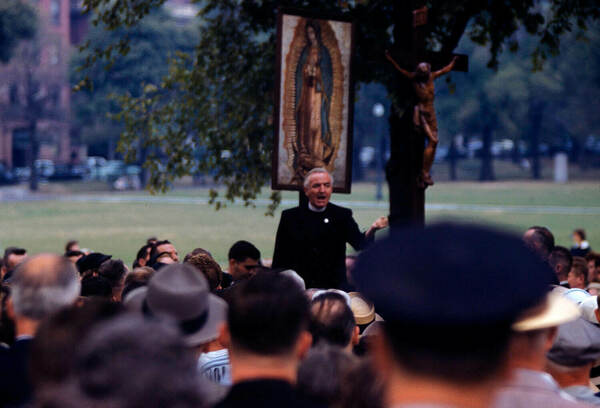
Writing to Ottaviani, Fenton acknowledged that Feeney’s understanding of salvation doctrine was “obviously a little inaccurate.” He conceded that Feeney’s questionable teaching together with his defiant attitude justified the censorship measures taken by Boston Archbishop Richard Cushing and by Feeney’s Jesuit superiors against him and the St. Benedict Center. However, Fenton worried that “to the American people, the condemnation of these men has appeared, not as a triumph of genuine Catholic doctrine, but as a victory for what is something like a ‘Catholic liberalism.’” Fenton lamented that “once again the men who have reacted against that indifferentism which is the true danger to the Church here in this country have been discredited.”8 In so doing, he echoed rather than challenged the increasingly hysterical rants raining on the Holy See about indifferentism from Feeney and his associates (in May 1949, Feeney appealed directly to Pius XII, denouncing “the wild liberalism of the American hierarchy,” and insinuating that with “every day [the Pope] defer[red] calling a halt” to it, “the more will grow the spirit of indifference and apostasy in our land.”)9
Ottaviani congratulated Fenton on the zeal shown in reaching out to Rome, captioned his letter with a flattering short bio, and forwarded it to the expert theologians (consultores) charged by the Holy Office cardinals with the task of evaluating the Feeney affair and proposing the appropriate Roman response.10 Yet, the consultores were not as impressed with Fenton’s report as Ottaviani had been. While appreciating the danger that “the necessary reaction against those who exaggerate falsely and erroneously [might] favor indifferentism,” consultor Sebastian Tromp (1889–1975), a Dutch Jesuit, concluded his analysis of Fenton’s considerations by deeming him “no good informer. He exaggerates, misquotes, reports things out of context, and does not seem objective.” More broadly, Tromp rejected Fenton’s and Feeney’s depictions of U.S. Catholicism as corrupt and declining, contrasting them to the show of strength and faithfulness offered by American Catholic soldiers and chaplains deployed to Europe during World War II. “I don’t know,” he candidly confessed, “whether, in cooperating with Protestants or Jews, bishops always and everywhere act with due prudence, and if there are abuses in the U.S. of the kind we deplore elsewhere.” But if that were indeed the case, Tromp reasoned, the Holy See would certainly intervene on a case-by-case basis. Sweeping charges of liberalism or indifferentism against the whole hierarchy were implausible and counterproductive.11 Tellingly, the Dutch Jesuit was as far as one could be from “Catholic liberalism.” In fact, he would go on to be an outspoken representative of the conservative minority at the Second Vatican Council. Still, also in light of the greater acquaintance with U.S. Catholicism that the war and postwar circumstances had somewhat forced upon Roman officials, he was unwilling to take the bait of any Americanist witch hunters.
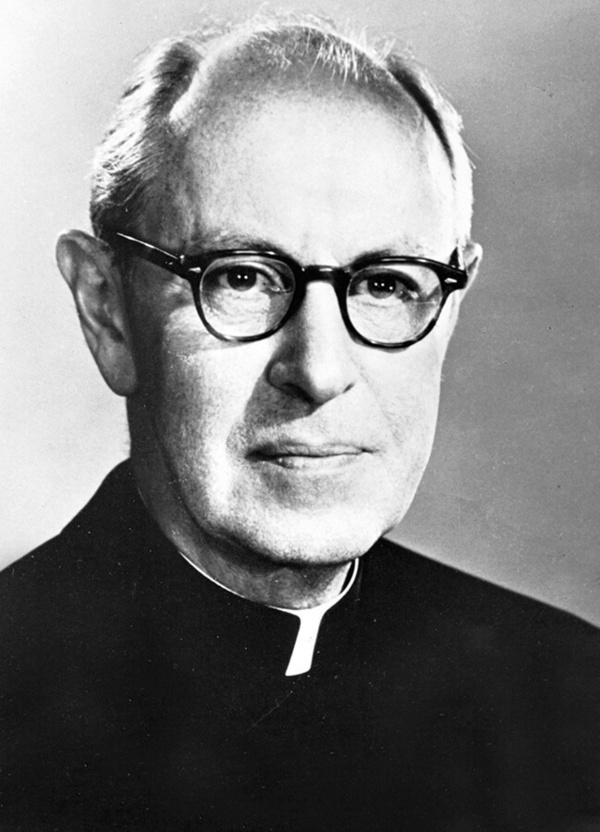
Undaunted, Fenton kept working with Ottaviani through the 1950s. Not only did he continue to sympathize with the Feeneyites and their consistent criticism of “what they consider (sometimes, I am sorry to say rightly) as unorthodox published statements by American Catholics,” he also found the perfect target in another Jesuit, John Courtney Murray.12 Murray, a professor at Woodstock College and editor of Theological Studies, was indeed trying quite explicitly to adjust Catholic church-state doctrine to modern conditions of religious pluralism and ascendant democratic sensibilities, which could hardly stomach civil inequality and privilege-granting agreements like the concordats. In a nutshell, Murray suggested that if the Church embraced the “marketplace of viewpoints” challenge and focused its efforts on making the most persuasive case for the Truth rather than seeking to insulate desired policy outcomes from risky democratic procedure, Rome had nothing to fear from a religious freedom regime like the American one. In the pages of his American Ecclesiastical Review, Fenton rushed to label Murray’s arguments as unorthodox and at odds with Roman pronouncements (which they were).13 But he also reported them to the Holy Office as a symptom of heresy rampant in the United States, once again invoking Roman intervention. “The teaching of Murray,” Fenton wrote Ottaviani, “is essentially the same Modernism against which Blessed Pius X fought so valiantly. It is likewise the continuation of the ‘Americanism’ condemned by Leo XIII in Testem benevolentiae.”14
For John Courtney Murray, the Church would have nothing to fear from religious freedom if, embracing the “marketplace of viewpoints,” it focused on making the most persuasive case for the Truth.
In the spring of 1954, when the Holy Office cardinals finally decided to launch an investigation into Murray’s work, Fenton acted as one of the consultores, formally recommending a public Roman condemnation of the Woodstock Jesuit, who “personified” the allegedly widespread “tendency toward the ‘American tradition of separation’ as something distinct and superior to Catholic teaching.”15 But Fenton’s arguments and suggestions did not go unchallenged. His fellow consultor, Michael Browne, an Irish Dominican who served as master of the Sacred Palace (the Pope’s theologian-in-chief), also found Murray’s arguments unconvincing. How could a religious freedom regime ensure civil legislation’s harmony with Catholic teaching? It could never be deemed as reliable on that score as a confessional regime, Browne reasoned. But he also appreciated Murray’s intent and work and thought that “[b]esides the doctrinal deviation,” the Jesuit was “a good and serious cleric.”16 The cardinals eventually voted to officially admonish Murray (though only privately, against Fenton’s wishes) “because of the errors advocated by him” and that he be prohibited “from writing or lecturing on church-state relations ever again.”17 When the cardinals’ decision was finally submitted to the Pope for his approval, however, Pius contested the formula “because of the errors advocated by him” and ordered the Holy Office to spell out exactly which theses were reproached. More significantly, the Pope deemed the injunction never again to write or lecture on church and state “excessive prohibition.” It would be enough for Murray to submit any new writings on the subject to the Jesuit General Curia for prior censorship.18
Fenton made no attempts to hide his dissatisfaction. He kept writing to Ottaviani, insisting that as long as the Holy See refused to condemn Murray publicly, his ideas would keep circulating and American Catholics would stand confused as to whether there still was such a thing as a Roman “line” on church and state, unfavorable to religious freedom in principle, or it was now a debatable subject on which a plurality of opinions could legitimately coexist. Ottaviani pushed the Holy Office cardinals to consider the issue again the following spring, and they finally voted to have Roman opposition to Murray’s church-state theories made public in the United States. Yet, Pius XII intervened again to delay the cardinals’ decision.19
Interestingly, among the evidence Fenton had produced to show that Murray and his theories continued to enjoy public favor in the United States despite their unorthodox character was the news that the Jesuit had been “one of the leading participants in ‘the first National Conference on the spiritual foundations of American Democracy,’” held in Washington, D.C., in November 1954.20 The conference had been the launching event for the Foundation for Religious Action in the Social and Civil Order (FRASCO), started by Episcopal clergyman Charles W. Lowry, Quaker D. Elton Trueblood, and Presbyterian minister Edward L. R. Elson, President Dwight D. Eisenhower’s pastor, as an interfaith alliance against communism. Fenton evidently understood involvement in such an organization as inherently compromising. Yet, unbeknownst to him, the Holy Office had already vetted FRASCO.
In the fall of 1954, the cardinals had charged the same Father Browne, who had already weighed in on the Murray affair, with establishing whether Catholics could participate in the foundation’s activities in good conscience.21 Browne argued that FRASCO’s founders wanted “to ground their agenda in God as the author of the natural law to positively affirm the latter, not as distinct from the God of the Christian Revelation, but as opposed to communistic atheism”—much like a Mason father could either teach his child to obey his parents out of reverence for the Great Architect of the Universe as distinct from the Christian God (inadmissible) or teach the same precept of natural religion without entering into any discussion of its supernatural foundation (admissible). The Dominican believed that Catholics could—in fact, should—combat atheism “in union with all those who fight it honestly.” Yet, FRASCO’s proposed weapons included the defense of “true democracy, […] human freedom, and the common welfare of nations.” Browne objected that the foundation’s leaders were referring to the specifically American instantiation of these goods. And, “despite all the nice things one could say about America, one cannot say that the American understanding of the political common good, human freedom, and democracy as an ideal corresponds with the perspective of the Catholic Church on the same subjects.” American Catholics, he continued, were “allowed to accept those for what is in them that is good and true (which is a lot),” but could they be trusted to figure out for themselves where the American understanding deviated from Catholic teaching, and recuse themselves in such a circumstance? Browne did not think so. Therefore, he recommended that, after the inaugural National Conference, which they had already committed to, any Catholics involved with FRASCO “prudently find a way to disengage from [it].”22
This time, the cardinals departed from the master’s suggestion (already framed in rather complimentary tones) to reach a more lenient verdict. They judged that—provided that no interconfessional ceremonies took place, Catholic participants were doctrinally reliable, and the Church retained the right to prior restraint of any FRASCO publications—the matter could be left “to the free will of the American hierarchy.”23
The Holy Office’s varying response to his denunciations, carefully tailored to each case and itself the conflicted product of inner debates and back-and-forths, did not shake Fenton’s commitment to sounding the Americanist alarm. But, by the end of the 1950s, even the Holy Office’s lowly clerks were increasingly annoyed by the “continuous stream” of letters coming from the American prelate. “Monsignor Fenton writes with the utmost confusion: I almost went crazy to gather the information left and right!” Moreover, some of his conclusions appeared “far-fetched.”24 In 1957, he sent Ottaviani a newspaper clipping, “sounding almost scandalized,” according to an anonymous clerk, “because the Archbishop of Washington, D.C., undersigned this letter addressed to President Eisenhower by the leaders of religious confessions.”25 The following week, consultor Tromp, once again called to evaluate Fenton’s denunciations, found nothing objectionable in the letter and concluded that “Monsignor Fenton seems sometimes inclined to a certain excessive severity.” In America, Tromp plainly observed, there was actually “no danger of false irenicism,” and people could perfectly distinguish between religious and civil cooperation.26
Romanity itself was an elusive, contested category, and Roman views of American Catholicism were becoming increasingly more articulate.
Throughout his career, Fenton claimed the mantle of Romanity against the Americanists. From the perspective of the “immigrant Church” historiography, he did so as one “among the last representatives of a Catholic subculture straining not to give way to the ‘progress’ of once-immigrant Catholicism into the American mainstream.” And his Romanity was “a theology that enabled the Catholic community to make up in self-esteem what it lacked in economic and social status.”27 Meanwhile, Roman sources allow us to see the stakes of Fenton’s arguments beyond the domestic issue of assimilation. The image of the stubborn traditionalist in cahoots with prejudiced Roman officials unappreciative of American modernity gives way to that of an often-criticized contributor to a much broader and more nuanced conversation. Italians, Americans, Dutch, Irish, and several other nationalities represented in the Curia weighed in on the issue of how best to deal with religious pluralism and disestablishmentarian democracy. If most Roman officials remained unpersuaded by Murray’s arguments (some, like Browne and Tromp, even at the Council), it was not because Rome was simply a den of anti-Americanist reactionaries. Romanity itself was an elusive, contested category, as Fenton soon discovered. Conversely, Roman views of America and American Catholicism were becoming increasingly more articulate, even for those officials who still considered Americanism a heresy.
Roman sources help us see that the question of how Catholics belong in the American nation—how they participate in its institutions, what they embrace of it, and what they critique—was, in fact, the subject of a transnational debate. Moreover, by the mid-20th century, while “liberalism” and “indifferentism” were still perceived as threats, the notion that they were especially popular among U.S. Catholics was waning in Rome, Feeney’s and Fenton’s allegations notwithstanding. Americanism and Romanity can comprehend the complex historical reality of U.S. Catholicism only when their interplay over time, rather than their seemingly polar opposition, is foregrounded.
Susanna De Stradis is assistant professor in the Department of History at Mississippi State University. She earned her Ph.D. in history from the University of Notre Dame in 2022. From 2022 to 2023, she was a postdoctoral research associate at the John C. Danforth Center on Religion and Politics at Washington University in St. Louis.
This article appears in the spring 2025 issue of the American Catholic Studies Newsletter.
Notes
1. Press release of the Dicastery for the Doctrine of the Faith, July 5, 2024. Available at: https://press.vatican.va/content/salastampa/it/bollettino/pubblico/2024/07/05/0554/01148.html
2. The text of the letter can be found at: https://edwardpentin.co.uk/archbishop-vigano-to-president-
trump-the-great-reset-is-a-plan-to-impose-a-health-dictatorship/
3. Jay P. Dolan, The Immigrant Church: New York’s Irish and German Catholics, 1815–1865 (Notre Dame, IN: University of Notre Dame Press, 1975) and The American Catholic Experience: A History from Colonial Times to the Present (Garden City, NY: Doubleday, 1985).
4. Matthew J. Cressler, Authentically Black and Truly Catholic: The Rise of Black Catholicism in the Great Migration (New York: New York University Press, 2017); Timothy Matovina, Latino Catholicism: Transformations in America’s Largest Church (Princeton, NJ: Princeton University Press, 2011); David J. Endres (ed.), Remapping the History of Catholicism in the United States: Essays from the U.S. Catholic Historian (Washington, D.C.: The Catholic University of America Press, 2017).
5. Kathleen Sprows Cummings, “Frances Cabrini, American Exceptionalism, and Returning to Rome,” The Catholic Historical Review 104, no. 1 (2018): 1–22.
6. Peter R. D’Agostino, Rome in America: Transnational Catholic Ideology from the Risorgimento to Fascism (Chapel Hill, NC: The University of North Carolina Press, 2004); John T. McGreevy, Catholicism and American Freedom: A History (New York: W.W. Norton, 2003).
7. The text of the encyclical is available at https://www.vatican.va/content/pius-xii/en/encyclicals/documents/hf_p-xii_enc_29061943_mystici-corporis-christi.html. The quotation is from paragraph 103.
8. Fenton to Ottaviani, April 24, 1949, p. 1, (R.V. 1949), n. 20, “Soc. Jesu Boston. Dottrina e caso del P. Leonardo Feeney (A),” Dubia, Res Doctrinales, Archivum Sancti Officii Romani (ASOR), ACDF.
9. Feeney to Pius XII, May 28, 1949, p. 6, (R.V. 1949), n. 20(B), Dubia, Res Doctrinales, ASOR, ACDF.
10. Ottaviani to Fenton, May 17, 1949, p. 1, (R.V. 1949), n. 20(A), Dubia, Res Doctrinales, ASOR, ACDF.
11. Sebastian Tromp, Votum, June 9, 1949, (R.V. 1949), n. 20(B), Dubia, Res Doctrinales, ASOR, ACDF.
12. Fenton to Ottaviani, September 6, 1952, 89, (R.V. 1949), n. 20(E), Dubia, Res Doctrinales, ASOR, ACDF; Fenton to Ottaviani, January 8, 1955, (R.V. 1951), n. 69, “Vol. IIC. Chiesa e Stato. Concezioni di P. Murray, SJ,” Dubia, Res Doctrinales, ASOR, ACDF.
13. See, for example, J. C. Fenton, “The Status of a Controversy,” American Ecclesiastical Review 124 (June 1951): 451–458; “Principles Underlying Traditional Church-State Doctrine,” American Ecclesiastical Review 126 (June 1952): 452–462.
14. Fenton to Ottaviani, April 22, 1954, 121, (R.V. 1951), n. 69, “Vol. IIA. Chiesa e Stato. Ideologia di P. Murray, SJ, (1).” Dubia, Res Doctrinales, ASOR, ACDF.
15. Fenton, Votum, [June 1954], 266, (R.V. 1951), n. 69(IIA2), Dubia, Res Doctrinales, ASOR, ACDF.
16. Report of the chancery, [June 1954], p. 17, (R.V. 1951) n. 69(IIA2), Dubia, Res Doctrinales, ASOR, ACDF.
17. Relatio Feria IV, July 7, 1954, 286, (R.V. 1951) n. 69(IIA2), Dubia, Res Doctrinales, ASOR, ACDF.
18. Pius XII, handwritten note, July 15, 1954, 299, (R.V. 1951), n. 69(IIA2), Dubia, Res Doctrinales, ASOR, ACDF.
19. Anonymous office note, November 30, 1956, 53r-v, (R.V. 1951), n. 69(IIC), Dubia, Res Doctrinales, ASOR, ACDF.
20. Fenton to Ottaviani, January 28, 1955, 369, (R.V. 1951), n. 69(IIA2), Dubia, Res Doctrinales, ASOR, ACDF.
21. Handwritten note from the plenary congregation, October 9, 1954, 36, (R.V. 1954) n. 16, Dubia, Res Doctrinales, ASOR, ACDF.
22. Voto del Rev.mo Padre Browne, O.P., Maestro del Sacro Palazzo Intorno alla Foundation for Religious Action in the Social and Civil Order [handwritten copy], October 13, 1954, 43–47, (R.V. 1954) n. 16, Dubia, Res Doctrinales, ASOR, ACDF.
23. Office note, October 18, 1954, 68r-v, (R.V. 1954) n. 16, Dubia, Res Doctrinales, ASOR, ACDF.
24. Anonymous office note [December 1956–January 1957], 110, (R.V. 1951), n. 69(IIC), Dubia, Res Doctrinales, ASOR, ACDF.
25. Anonymous typewritten note, February 2, 1957, (R.V. 1948), n. 39, Prot. 174/57 “Sugli omaggi interfede a Eisenhower,” Dubia, Res Doctrinales, ASOR, ACDF.
26. Tromp, “Epistola ad Praesidentem Eisenhower,” February 11, 1957, (R.V. 1948), n. 39, 174/57, Dubia, Res Doctrinales, ASOR, ACDF.
27. R. Scott Appleby and John H. Haas, “The Last Supernaturalists: Fenton, Connell, and the Threat of Catholic Indifferentism,” U.S. Catholic Historian 13, no. 2 (1995): 23–24.