
In our moment of heightened partisan tensions, it is little surprise that our email inboxes at the Cushwa Center populate quickly with requests from journalists and press outlets for help explaining the latest trends in Catholic political engagement. Still, the recent (and ongoing) back-and-forth between President Donald Trump and Pope Leo XIV has generated more than the usual stream of inquiries, and more pointed inquiries as well: Will the president’s brouhaha with the pontiff break his Catholic support in the midterms? Does the sparring between the White House and Vatican hurt (or help) J.D. Vance’s chances in 2028? Trump’s prodding is standard practice, but should Pope Leo speak with such an edge?
The blitz has served as a reminder of the Cushwa Center’s vital role in providing critical commentary for news reporting on Catholicism’s sustained presence in contemporary American life. Although it may have taken time, and some coaxing, for Cushwa founding director Jay P. Dolan to embrace a public relations mission, in this regard, since the 1990s directorship of Scott Appleby (Dolan’s successor, and the man doing the coaxing), Cushwa leaders have done their part to provide informed and accessible analysis that can assist a wider public’s grappling with the times.
It has rarely been an easy task. Mass media has always insisted on brevity and punch on the part of its analysts, and in this current TikTok age of algorithmic filters, catchy soundbites are not simply the currency but the demand of a sprawling culture industry that shifts gears in a second. For scholars who embrace the slow-burn approach to information gathering and dissemination, such expectations for instant impact can be intimidating as well as disquieting, and overall difficult to navigate. How can one be expected to trim years of research on U.S. Catholic-Vatican relations to a tagline or distill the Church’s social teaching down to catchphrase or sound grab?
Having plugged away, trying to make historical research on U.S. religion and politics matter for current conversations, I know the challenges of making academese digestible for public consumption. Which is why I am particularly impressed with the work Cushwa Co-Director David Lantigua has done lately to shed light on the “politics” of church and society through the prism of Catholic social teaching. While the soundbites have been forthcoming, his contributions to mainstream media (most recently, the New York Times) and the Catholic press (Commonweal and National Catholic Reporter, among others) have also demonstrated the power of the slow-burn approach—the pause for context and reflection that a professor of theology and history can encourage in a society dictated by speed. (For a running list of media hits, see cushwa.nd.edu/news/in-the-media.)
Besides promoting that method with the pen, David has also done so through community engagement, in settings where the heated issues of the day (White House vs. Vatican, immigration, labor, and justice) can be processed purposefully in a spirit of collective dialogue, with theological truths applied to the real world and the common good always in mind. If there is an answer to the frantic, hyper-politicization of our moment, and an antidote to the kneejerk partisanship of our doom-scrolling culture, it is the type of small-scale performances of civil society that David and the Cushwa Center have helped nurture through these grassroots encounters.
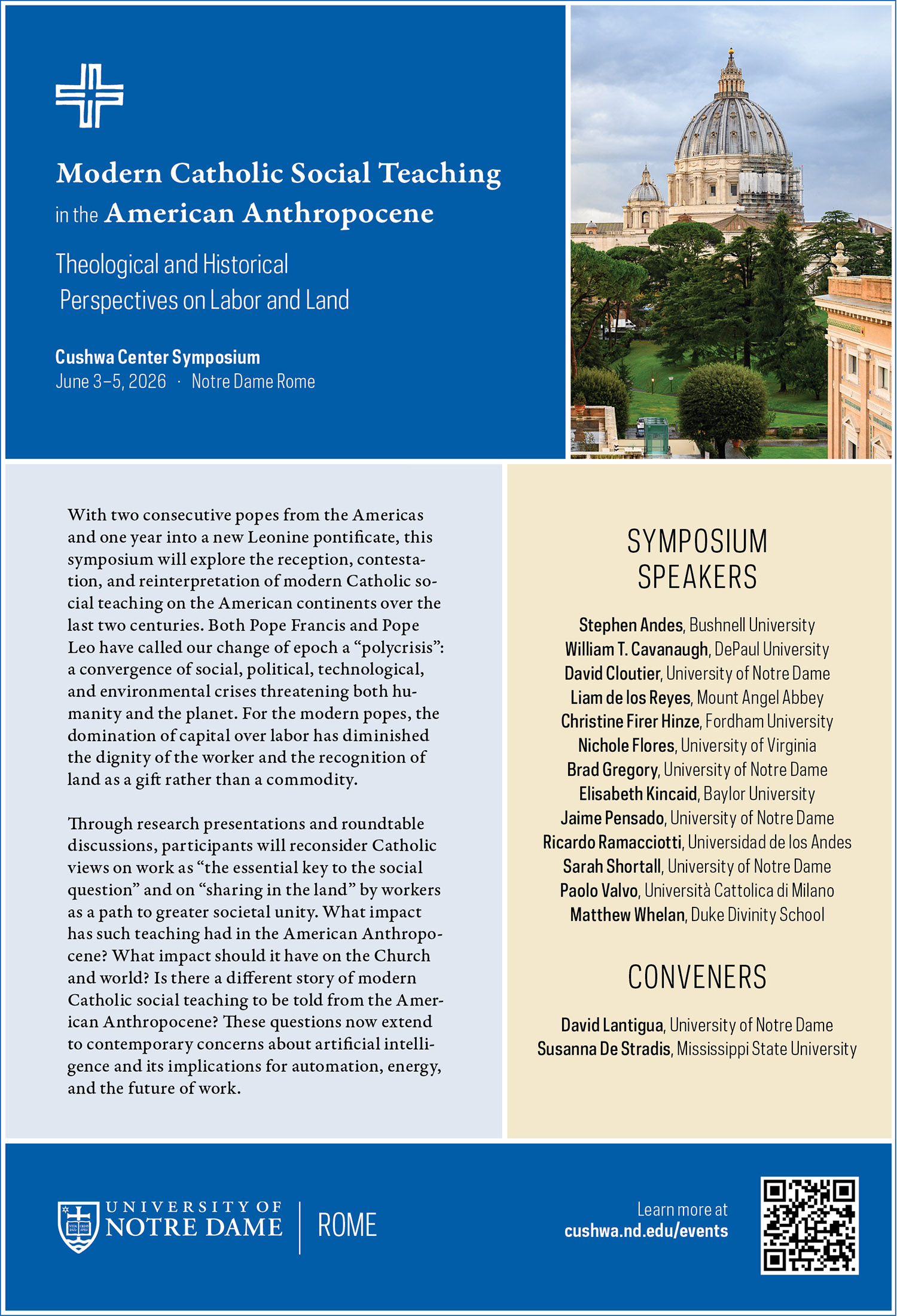
Strengthening civil society through patient analysis and application of Catholic social teaching is a goal the center has laid out for two other initiatives that loom large now, both of which reaffirm the potentials of faith-aware scholarship at different levels. During the first week of June, the Cushwa Center in conjunction with Notre Dame Rome will host a three-day symposium on “Modern Catholic Social Teaching in the American Anthropocene,” which will see more than a dozen historians, theologians, and political theorists engage in cross-disciplinary discussion about the “reception, contestation, and reinterpretation of modern Catholic social teaching on the American continents over the last two centuries.” Drawing inspiration from calls from Pope Francis and Pope Leo for Catholics and citizens of the world to address the “polycrisis” of the age (accumulating crises of the social, political, technological, and environmental sort) through rigorous interrogation of Catholic social thought and its application to matters of “labor and land,” those invested in the initiative will also be encouraged to ponder the potential impact of the Church on our current world, tested as it is by so many other concerns as well—those, for instance, related to artificial intelligence (AI) and energy. Coming on the heels of Pope Leo’s first encyclical on May 15, 2026—in which he is expected to address AI, peace, and global order, the symposium will surely be shot through with a fresh sense of urgency. One could hardly imagine a timelier gathering.
Meanwhile, while drafting this brief note, I have frequently stopped typing to read through the stack of undergraduate essays sitting next to my computer—essays submitted by undergraduate students at Notre Dame, Saint Mary’s College, and Holy Cross College for the Cushwa Center’s inaugural Undergraduate Research & Writing Prize. It is apparent that college students have much to say about the study of American Catholicism and its inherent value to understanding modern America as a whole. Among the almost three-dozen entries we have received are richly researched think pieces about Catholic social teaching and carbon energy, war, AI, healthcare, and the environment—and about the impact of rapid cultural change on the Church itself as it has piloted decades of societal transformation in the United States—decades of change often as polarizing and dividing as the one we now inhabit. If my initial glance at the papers is any indication, it seems that youth on these three campuses are eager to provide civil answers to the heated circumstances we now find ourselves in—circumstances their elders have helped create or simply found too vexing to fix.
As I finish my three-year term as co-director at the Cushwa Center and move into a new administrative role as chair of Notre Dame’s Department of History, I am heartened by the enthusiasm these college students have shown, not just in response to a call for papers (and a prize), but in eager reply to the most daunting conundrums of the day. I look forward to seeing these students, and all those we have the privilege of teaching here, take the reins to guide us to a reimagined future. But that is in the long term; in the short term, I am most excited about witnessing (from striking distance in Decio Hall) the important work David, Shane, MaDonna, and a new cohort of postdoctoral fellows will continue to carry out in order to guarantee that the Cushwa Center is always at the heart of—and generating—the hard and vital conversations that church and society—scholars and a general public—need to engage collectively, contemplatively, and for the common good.
Darren Dochuk
William W. and Anna Jean Cushwa Co-Director
This director’s note appears in the spring 2026 issue of the American Catholic Studies Newsletter.